Unity Development
Recently active
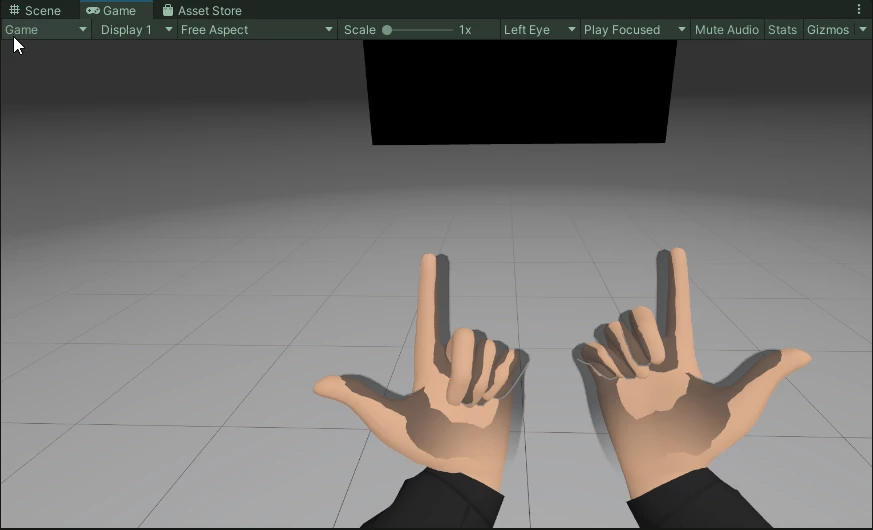
am trying to implement ovroverlay underlay but nothing work for me what i did is the following1- add quad with ovroverlay and set type to underlay2 - add quad with same size and same position with shader oculus/underlay imposterwhen i build i get only black quad am i missing something?
I am developing vr app with unity, everything works fine but i am having trouble with menu as i cant see menu in the app after doing some changes to other components and if i again bring new camerarig from working scene it works fine, i am not doing any change in camera rig but i dont know my menu is there as i inspect with remote inspector but could not see ui or menu until i change to new camera rig. Please help me with thisThanks in advance
So i've made a custom patching system for my occulus go app and i'm trying to install the new APK.Everything works fine except this prompt that pops up renders once on each screen (so its double visioned) and I can't seem to interact with it.Is this a bug? Help :(
Hello! I am making a VR game in Unity, and when I try to launch it, it gives a splash screen, then crashes. It works fine in the Unity Editor, but when I sideload it to the quest, it does it. And note that It was working fine before (When we built other versions earlier back) then, I had not added any packages or anything. When I was on one of the previous builds, (Which was unaffected before) It just started doing it for no reason. I released a new version in an attempt to fix it, but it didn't work. This is a video of what I mean by "crashing", and This is the Oculus Logs File I received from MQDH. Thank you. If you need any more info, let me know.
Hello everyone, I have a problem when compiling my app for quest 2, the problem is that when compiling and uploading it to applab, everything loads correctly without problems, but when the app starts, it loads with the 3 points forever, the app never starts
I'm making a VR simulation that uses Vuplex's WebView for Android - the canvases are taken from the poke interaction scene, with a WebView added to the Unity Canvas. Most of them load up just fine, but the one webpage I have is popping up an error about render resolution being too high. This seems to be some kind of WebGL problem (since it has a max size of 4096), but sizing down the canvas resolution hasn't stopped this error.We've had this error pop up on our computers as well, but it was fixed by updating Chromium to v115. It seems like the Quest is only on Chromium 91. Is there any way to update this outside of an Oculus update, or are we just kind of screwed until that happens? Does anyone have other suggestions to try?
READ_PHONE_STATE, ACCESS_COARSE_LOCATION, ACCESS_BACKGROUND_LOCATION, and ACCESS_FINE_LOCATION.Of all the permissions listed in this error, I am not using a single one. They are not included anywhere in my android manifest file, which I have confirmed is the one I'm using via the unity project settings. What is causing this?
I was very surprised to discover that hand typing (direct interaction) on the virtual keyboard (OVRVirtualKeyboard) was only possible with index fingers, i.e. other fingers don't register any contact with the keyboard. Why on earth was that design choice made? If it's to mimic other input methods which use single contact points for each hand (controller, ray) or to minimise false positive touches with the other fingers because hand tracking isn't sufficiently reliable, why not at least include configuration options in the OVRVirtualKeyboard script to toggle direct interaction support for each individual finger for when tracking becomes more robust or simply if users want to use multiple fingers to type?But maybe devs at Meta code with their index fingers only. That would explain a lot about how the development experience for the Quest was designed.
Dear admin, Where can I find the Unity package for Hand Tracking 2.2 from v56?I cannot find it even though Meta has announced that it is released...Could you share a direct link to the package? If it is not out yet, then could you provide an estimate for when it will be released?
Hello! I am working on a Unity 3D URP game for the Oculus Quest. The game works great on the Oculus Quest 2; however, I would like to have the game working on iOS and Android tablets as well. May I ask if there is a way to do this? Can I make one Unity application that can have successful iOS, Android, and Oculus Quest 2 builds? Thank you in advance!
A securitização de crédito judicial é um processo financeiro que tem ganhado destaque no cenário jurídico e econômico, oferecendo uma abordagem inovadora para a gestão de ativos e a otimização de recursos. Nessa vanguarda está o renomado especialista em securitização de crédito judicial com uso de blockchain e inteligência artificial, Augusto Galia, cujas contribuições têm revolucionado a forma como encaramos essa modalidade de investimento. A essência da securitização de crédito judicial reside em transformar recebíveis judiciais em ativos financeiros negociáveis, proporcionando uma valiosa liquidez para empresas e instituições financeiras. Esse processo é especialmente benéfico para empresas que possuem créditos a receber em processos judiciais, uma vez que possibilita antecipar o recebimento desses valores e, consequentemente, liberar recursos para investimentos e expansão. A tecnologia blockchain garante maior segurança e transparência ao processo, uma vez que todas
My company has been trying to implement the Meta Avatars into a game we are developing. As many VR games do, this involves holding many different items in VR with different hand poses. The only example of a custom hand pose, is primitive at best, with the custom pose being 24 transforms with a Skeleton Renderer script. There is no way to model poses accurately, and you can't even see what it looks like with a skin, until you run it. Move a transform the wrong way, and your fingers are a tangled up mess. Meta has spent literally billions of dollars on various software and game development for the Quest, including the Avatar SDK. It absolutely baffles me that there is no available support for it. No good examples, the documentation is extremely lacking. At least give me a hand model or something that can be used to model a hand, other than a pile of bones (vectors). The oculus integration hands look similar, but models are not compatible.&nb
App records microphone input and sends it to a Speech To Text service.On the v55 Firmware this works fine with no issues.On headsets with the v56 Firmware, the microphone now provides nothing but garbled input (rushed and chopped up).I'm using the OVR Meta SDK and Vivox. Vivox is recording fine.Removing Vivox from the app still results in garbled input.Has anyone run into this? I can't imagine I'm the only one affected.
I am trying to use the Oculus Integration SDK (along with several other SDKs) to make a VR application with one other partner. We have permission to take info for the players' avatars from the Oculus, our developer modes are turned on, and we have everyone added to the project as Administrators. But, in Unity and when building the game, the application will only accept my & my partner's credentials. This means that we are the only 2 that has our avatars load in correctly, and everyone else's credentials are not accepted & they remain invisible in the game (they still load in to the scene, but their avatars do not).We have narrowed down the issue to a permissions error, when trying to log in on the "Oculus Platform Settings" > "Unity Editor Settings." Me and my partner are able to log in using our normal Oculus Developer credentials just fine, but no one else is able to, regardless of their permissions & roles on the project. It just spits out an error that says "Pl
When trying to upload a Vulkan only Quest app via the Meta Quest Developer Hub or the Oculus Platform Tool in Unity it's coming up with validation errors:GLES_VERSION_NOT_SPECIFIEDGLES version not specified (android:glEsVersion in AndroidManifest.xml). GLES version of 2.0 or greater should be used.and This app contains both 32-bit (armeabi-v7a) and 64-bit (arm64-v8a) libraries. This consumes extra storage and increases download times. Consider updating your build to target 64-bit only.The issue being that it uses Vulkan only and haven't had issues uploading with Vulkan only before.Also, only ARM64 was checked in the player settings in Unity and didn't get the validation error on previous upload.Using Unity 2021.3.26 and Oculus Integration v53
Hi,I'm currently trying to use Avatar SDK 2 to display different NPC avatars preset to the player so he can quickly choose a skin before to enter the game.I need the 3rd person NPC Avatars to rest in a custom pose, so I did successfully implemented the custom hand pose and wrist offset, it works fine in the editor, but at runtime the NPC wrists are tracking the player hands as soon as the tracking context is set to animate the 1st person avatar. Question 1: Is bodytracking behavior required to set custom wrist position? I mean, does the avatars always have to use tracking behavior for them to be in a specific pose?Question 2: If the answer is yes, how to implement custom fake tracking inputs that will not be overrided by the tracking inputs used by the actual 1st person Avatar?
When I run my game on a simulated environment through the Oculus Link, everything works fine.However when I build the app and run it on the Quest 2, the view from the previous cinematic persists for the first few frames. I have already tried these methods:RenderTexture rt = UnityEngine.RenderTexture.active;UnityEngine.RenderTexture.active = myRenderTextureToClear;GL.Clear(true, true, Color.clear);myRenderTextureToClear.Release();UnityEngine.RenderTexture.active = rt; Yet the problem hasn't been solved.Are there any android specific things that I should know about?
I keep having extremely large values coming from the StandardVelocityCalculator that don't make sense with how the hand is moved. At first i thought it was tangential velocity influence, but turning that down still showed issues. However these issues would ONLY show up when making an APK and building to a device. Has anyone else experienced this?Note: This can be seen in the TransformerExample scene by just attempting to pick up and release an object (often with no controller movement at all)
I have an UI in the game, using a Canvas set to World Space, it doesn't matter if I move the UI camera further back or if I play with the scaling of the Canvas. It is very uncomfortable to look at, like I'm crossing my eyes.The 3d enviroment looks ok, any idea what could be the problem?
I've been using my Quest 2 with Quest Link for development for the last few months with no issues. However mysteriously around this week or last, (early July 2022), something has changed and now it only works the first time I hit play. Subsequent times I get this warning: Unable to start Oculus XR Plugin.Possible causes include a headset not being attached, or the Oculus runtime is not installed or up to date. Then I have to restart Unity to get quest link working again. This is a massive productivity killer so hoping there is an easy fix to make unity editor play mode work repeatedly without requiring a restart.
I have a grabbable object, and I want it to triger a function of another class ScreenShotManager when it is grabbed, so I announce a variable like thispublic ScreenShotManager shotManager;But it throws an error when compiling: Assets\Oculus\Interaction\Runtime\Scripts\Interaction\Grabbable\Grabbable.cs(47,16): error CS0246: The type or namespace name 'ScreenShotManager' could not be found (are you missing a using directive or an assembly reference?)The ScreenShotManager.cs is under Assets\Tests\Scripts and it doesn't belong to any namespace. How could I solve this?
Are there any recommended beginner-level video tutorials that show how to make a social VR experience using the Meta Avatar 2 SDK and PUN? I've spent weeks trying to understand the basics. Youtube has led me down a few dead ends. I've completed most of the Unity C# beginner tutorials, but they're not focused on the Meta Avatars, and the Photon PUN website support documentation makes very little sense to me. Please help. I am not a programmer by trade but I was hoping the learning curve could be abated by a good video tutorial series.
Hello everyone! I've been trying development with the new Meta Quest Pro and I just haven't been able to figure out passthrough. I tried setting up a project with online tutorials and when I build the scene, the passthrough is black. Even in the sample passthrough scenes that come with Oculus Integration Package, the passthrough looks black. The project should be set up correctly. I followed this Step By Step: http://www.lancelarsen.com/xr-step-by-step-setting-up-mixed-reality-passthrough-for-your-oculus-quest-xr-project-in-unity-2021/?unapproved=4039&moderation-hash=94fd9f944a6ed0989e47da48bb71cb6e#comment-4039 I also looked at this video which went basically went through the same steps: https://www.youtube.com/watch?v=9u3QQi6Gnx0&t=207s I also tried the scenes with the Meta Quest 2 and the passthrough was still black. Anyone got any ideas?
I'm part of a research effort investigating using the Quest Pro. We need access to the passthrough layer to manipulate it. This is not possible in the default SDK in e.g. Unity and wondered if any one have any contact we could reach out to at Oculus/Meta to move forward with this research?
The SDK was imported into Unity2021.3.19 and can be used as a control handle, but there is no voice recognition. When the project is closed and reopened, the DLL cannot be found
Already have an account? Login
Enter your E-mail address. We'll send you an e-mail with instructions to reset your password.