Unity Development
Recently active
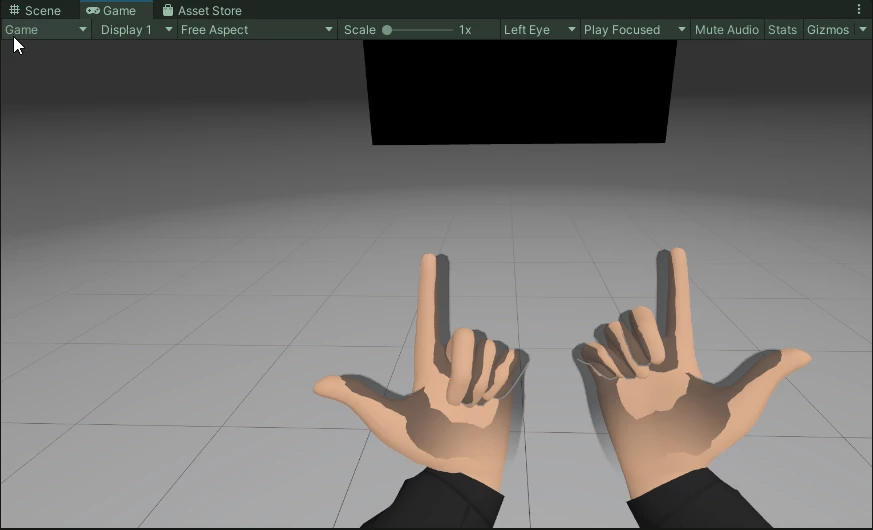
Issue: While using both Meta Avatars and Hand Interaction SDK, my fingers don't align in certain positions.Pressing a button on a canvas with only the Meta Avatars hands visible is inaccurate and leads to misses or accidental button clicks. I understand I can pass custom data to the Interaction SDK hands but seems like a lot of trouble.Here are examples. Certain angles are worse than others. Certain angles seem to be aligned well.
HI, I have an issue with TextMeshPro rendering when using FXAA. The long and short- the game uses URP- the game we are working on uses the Deffered Render Pipeline due to performance considerations- because of this MSAA in URP settings is not available- therefore FXAA on the Camera is the solution to reduce hard edges- [Problem] The TextMeshPro text now has very bad artefacting which makes them hard to read. Is it possible to reduce this or exclude it from the FXAA pass? Tali
We are working on a mixed reality application where we want to use meta avatars, alongside that we are also working on a small desktop companion app where we would like to access those avatars. Our question is is it possible to access user's and other user's avatars on the desktop without having Oculus desktop app installed?
For some reason hands tracking is not working anymore in Unity editor.Tried with Quest Link and with Air Link.Tried in a clean project with the latest updates and Quest Pro.Tried in some old project for Quest 2 (and with Quest 2) where everything was fine a few month ago. Nothing.Checked with Oculus Integration examples - controller ok, hands are absent in the editor.In latest Unity Movement examples eye & face tracking works, controllers works, but no hands tracking, no head movement mirroring, no hands mirroring even with the controllers in the scene.And of course I tried to reboot everything.No errors in editor, but some warnings appear (only sometimes):I will be grateful for any help. Windows 11Unity 2021.3.4/2021.3.13Oculus Integration v46Oculus XR 3.2.2-pre.1Oculus app version 46.0.0.230.0 (46.0.0.229.0). I tried latest Oculus app, then switched to test channel - no changes.Quest Pro v46.0.0.226
Hello,I have a question regarding the new Meta Avatars SDK that recently came out. I wanted to ask how can I use the full manifestation for an avatar? In the Unity inspector, when I change the Active Manifestation to Full, the avatar just disappears. But the skeleton contains all the bones including the legs. So please guide me on how I can use the full body.Thank you
I'm developing a project on Unity and using 2022.2.11f1 as the version. (I tried 2020 and 2021 LTS versions)The hands are working smoothly when I run the scene in Unity, but the hands are not visible when I build out windows.I tried more than one way and also got builds from unity's own samples, but the result did not change.How can I solve this problem?
Hello all,I am making a game where I want the player to enter a house. I am covering the house entrance with a game object which will be invisible. I want the object to disappear when players say a certain term or sentence, I am using the meta voice SDK but cannot figure out how to do this. If I am right I need a script attached to the object that makes it disappear, a button input to actually record someone's voice, and an event handler. I have already trained the utterances on Wit.ai
Hello Guys, I am making a quite big world for my game in Unity for Oculus Rift. Initially when I tried my game with default settings it looked somewhat blurry and mesh edges were flickering like a hell (especially trees). So I changed RenderScale value to 2 from 1. It made huge difference in my game quality but FPS went below 60 and then I adjusted RenderScale value to 1.2 so now my game quality is okay and FPS is also okay. But the problem I'm facing now is the flickering in mesh edges. I even tried with 8x MSAA but still flickering exists. Does anyone know how to solve this. FYI : THOSE FLICKERING PROBLEM IS ONLY IN OCULUS SCREEN, PC MONITOR DOES NOT SHOW THAT MUCH FLICKERINGOculus Version : Oculus Rift CV1Current Settings : Rendering Path -> Forward, AA -> 8x MSAA, VSync -> Disabled, Color Space -> Gamma, Stereo Rendering Method -> Single Pass. PC Specs : RAM -> 32GB, Processor -> Intel(R) Core(TM) i7-6700K CPU @ 4.00GHz 4.00 GHz, Gfx ->
I am developing an app that uses Unity to browse and play videos stored inside Quest (/mnt/sdcard/movies).Due to a recent update (either 51.0~53.0), it suddenly stopped working on all 5 of my Quest2 units. It works fine on devices that have not been updated since version 49.0.I need to know how to deal with it.
Hi developing a game for Oculus Quest 2 and have some problems regarding jitter in movement that is caused by a variation of delta-time.The jitter started when I introduced a fixed time loop of heavy operations. In my case I introduced a networking library that runs 60 times per second and therefore added some lag-spikes in the interval. But I have also added some artificial delays (sleep) to unitys-fixed update and notices the same behavior. My game still runs in the expected time-frame of 90 fps, but some frames take about 11 ms and others about 5 ms (example) which makes for a big variation in delta-time.Variation in frame-times has not been a problem in traditional pc games I have worked with before. The delta time is either made almost constant by the use of v-sync. Or necessary to variate to compensate for the variation in time between each presentation of the frame. And movement results are smooth.However it seems to be handled a bit differently on the Quest platform, I believe
I already used collision triggers in that project, but That collider won't trigger at all. I can't figure it out since everything looks fine.The player object has kinematic Rigidbody and collider not set as trigger, and is set to "Player" layer.The cube object has no rigidbody but a collider set as trigger, and is set to "Interaction" layer. "Player" layer and "Interaction" layer are set to interact with each other in Physics settings.
We are currently using a custom keyboard UI in our application since the system keyboard doesn't close properly when we click the enter/return/confirm button on the right (it opens right back up again and doesn't type anything). However, whenever we interact with a input field we get the following "error" message in the logs:Error: Oculus overlay keyboard is disabled, add 'oculus.software.overlay_keyboard' feature request to your Android manifest.Is there a way to disable this message or prevent input fields from triggering the system keyboard?
Currently if the input field is set as MultiLineSubmit, both enter button and close button doesn't work get you out of input state, the input field will stay focused on hence the keyboard will instantly comes back again. There is a similar post here but no straight forward solution is given, the OP has to implement some custom Android keyboard polling.
I have a project set up using the new interaction system following the guide. Here is my setup:To enable the keyboard overlay I checked the system keyboard box in OVR Manager settingsI have a FlatUnityCanvas prefab in my scene, and I added a PointableCanvasModule into the scene.I added both a legacy InputField and a TMP_InputField to the canvas prefab.Everything works when I build the APK to the quest 2 device. [well, the keyboard doesn't close.. but that's another story]However, in link mode, I can't type anything into Input fields. Previously, using OVRInputModule, I was able to type on my computer's keyboard in Link, but this doesn't seem to be working with the Interaction SKD set up.I can select the input fields (i tested by having a debug log when selected), but I just can't enter text.Am I missing something? or is this a bug? I tried adding an event system to the scene, standalone module, etc. Nothing seems to be working.
I just updated my project to Unity 2022 LTS. I started getting errors in the OvrAvatarPrimitive class around vertex buffer size miss-matches. I added a line to that class setting the vertex buffer parameters one more time right before the line that would give me the error which fixed my issues: //added this - the bug as that the mesh vertex buffer did not match the size of the data being set in the next code line mesh.SetVertexBufferParams(vertexBuffer.vertexCount, vertexBuffer.vertexLayout.ToArray()); // // Upload vertex data to the mesh. mesh.SetVertexBufferData(vertexBuffer.vertices, 0, 0, vertexBuffer.vertexCount * vertexBuffer.vertexStride, VF_STREAM_ID); mesh.UploadMeshData(true);Could be an isolated/project specific issue, but I thought I'd share if someone else is having problem.
Could you help me understand which is the latest (or most suitable) Unity version at the moment for supporting Quest 2 and Quest 3 devices? We are looking to migrate one of our projects to a new Unity version. Thank you.
Hi, I was wondering if anyone would be able to help with a SnapInteractor problem.In the SnapExample scene of the Oculus SDK the List Snap Pose Delegate is used to position moons and a planet added to a SnapInteractable. Moons and the planet can be moved around and snapped into the different positions moving other objects into surrounding positions.My question is, is it possible to get the position that the planet and moons are in as they are moved around.For example, when the scene starts the planet could be considered as being in position 0. I am wondering how I can get this information from the script.At the moment, the only way I can figure out how to do it would be by their transform position as they are moved around.I am not sure if positions are stored anywhere.
I am experimenting with the Oculus Integration Package and noticed, that when I want to use FingerFeatureSkeletalDebugVisual to visualize if I do HandPoses correctly, the _fingerFeatureStateProvider field is not set. Currently it is exposed to the inspector using [SerializeField] however since this object is created at runtime, the field never gets set. Therefore, I exposed the FingerFeatureStateProvider in the ShapeRecognizerActiveState-class (protected -> public) and injected it along other parameters in FingerFeatureStateProvider 's Initialize() method (which is called in HandShapeSkeletalDebugVisual). Everything seems to be working, however, this issue seems to be unintended behaviour on Oculus Integration's side. If not, please tell me where I did a mistake.
I want to know hoe to integrate oculus interaction sdk with spatial sdk. I want to develop space in Spatial where we can use Hand gestures to interact with 3d objects. I am trying to import oculus interaction sdk but it is having lot of errors.
Hi, I tried to build and deploy the Android application on Oculus Quest 2 (Unity). I used Shader to draw the surface of an object, meshRenderer.material = new Material(Shader.Find("Particles/Standard Surface")); Everything worked well until I built and ran on Quest 2; the object did not appear on Quest2.Do you have any idea to fix this?Thank you
Hi!I'm trying to make it so the player cannot teleport unless they are in the center of their play area. I have a system that detects the player's location, then sends Disable() or Enable() to all the relevant interactors (on each hand: Teleport Interactor, Turner Interactor, and the Best Hover Interactor Group in their parent). However, this does not seem to do anything.I tried an alternative solution that just Activates or Deactives the "LocomotionHandInteractorGroup" parent outright. This actually does stop the player from teleporting at unwanted times! However, it gets really janky. UI is floating all over the place! This is fixed by jiggling your hands a bit, but that's too janky and confusing for the player,Any tips on how to properly stop the player from teleporting? Thanks!
Mission.1. Create a 3D world with a single player to navigate through the scene.2. Publish the scene.3. Access the 3D world and Interact with objects discovered.4. Record interactions as completed, or assign a score. Save data to file for use later.5. End of MIssion.Thoughts? Simple enough?
I would like to know how Arkio in Oculus recognizes where the ground is in passthrough mode, or how Oculus achieves this effect. Please tell me some methods.
Hi there,When developing Oculus MR application in Unity using Oculus SDK, we can see the room data previously set up in the headset using Oculus Link in Unity editor, but after packaging the game as apk and run it on Oculus quest 2 headset, the MR application can't get the room data that has been set up. It will jump to the room settings in the system. After we finish the setting, click the Finish button and return to our MR application, it still do not have the room data.We printed the log in the UpdateHMDEvents in the OVRManager.cs file, and found that the data.Result=-1000 in the case of OVRPlugin.EventType.SpaceQueryComplete when packaged into the apk, which is different from the one printed when using the Oculus Link function in the Unity editor.Oculus quest 2 system versions we have tried: V50, V51, V53 Oculus SDK versions tried: V50, V51, V53 Unity version: 2021.3.16f1We would truly appreciate you help on how to fix the problem.Thanks and best regardsqu
Hi,I'm using the scripts from the Locomotion Sample Scene to teleport on nodes with left hand.And I have 1 problem as shown in the picture, tube renderer is not in hand position.I found the element called Procedural Arc but don't know how to configure it to hand position.Does anyone have any solution for this problem?Excuse my English and thanks for the help.
Already have an account? Login
Enter your E-mail address. We'll send you an e-mail with instructions to reset your password.