PCVR/Link Development
Recently active
So I've had long sessions within my VR headset, I'm sure most of us have. When I'm in these long sessions, I don't like taking off my headset and putting it back on to do many things. So far I could do pretty much everything I needed to except use the bathroom and read phone notifications.I can't really change the bathroom situation but I'm pretty sure I can fix the phone problem. So I made 2 c# applications, one for my phone and one for the PC, and got my phone to send notifications to my PC in real time. Heck if I really wanted to I could probably respond to messages. That's all fine and dandy but this leaves me sort of stuck.I was curious if it was possible to run a background app within the Oculus software that can send in notifications, sort of like when you get trophies?I don't want to result to just making it a windows form that uses the Oculus desktop, that's still sort of glitchy for me to the point where using the pullout can sometimes completely crash my headset.I'm well awa
Hello, I'm a Rift S C++ developer, on a custom engine written in GL running on NVidia GTX 1080 with fresh drivers and Windows 10. Yesterday, Oculus software updated itself to 19.0.0.364.531 and my app started failing. I updated to SDK 1.43 and the failure continued. My app supports VR and non VR mode, by donning/doffing the headset. I build and tear down swap chains on each don and doff respectively and this has been working for quite some time.The new failure:On every other donning of the headset, I get a failure in ovr_CreateTextureSwapChainGL that logs the following:26/07 23:59:00.339 {!ERROR!} [Kernel:Error] OVR Error: Code: -3000 -- ovrError_Initialize System error: 1282 (502) -- GL_INVALID_OPERATION Description: OpenGLChronometer::glGenQueries OVRTime: 636648.848896 Time: 2020-07-26 23:59:00 [339:861:200]And then I receive an ovrResult of -3000. If I leave the headset donned (using the proximity sensor), my app trie
l usb et le displayport ne sont pas souvent reconnu par l ordinateur ... cela fonctionne tres mal j ai un lenovo legion y540 gtx 1660 ti ic7 9750h et le casque ne fonctionne pas toujours
1. Error message when using Steam LIV software (The Oculus system has lost its connection to the display. Please check your headset's connection and then restart)Remove the LIV software to make it work , But there is no error in testing HTC VIVE.Steam LIV Customer service:LIV doesnt really do anything at that level. if your oculus is losing connection to the display it sounds like you have issues with your device or the oculus software so, there isnt really anything to fix there .Has anyone encountered this problem? thanks.
Essentially the title, can i fill out ovrTextureSwapChain manually with textures? i have an API agnostic engine and would like to create rendertargets and depth myself using data from the HMD and set up the swapchain myself. That way i can pass out my RenderHandles which function with the rest of the engine. Is this possible?
Hello!I'm new to Oculus VR development and having issues with trying to watch a bunch of tutorials on YouTube being extremely out of date. After doing what I assumed was the closest to current level development, I have been able to get my character to move using the touch controllers, enable hands (not able to grab yet), and for the most part, use the Oculus Rift S as much as I would want to in a VR game.However, after trying to get the "CharacterCameraConstraint" to work, I am now getting a Null Reference Exception whenever I try to run the game. I have the CharacterCameraConstraint component attached to the OVRPlayerController and have assigned the Camera rig to the proper reference. I have also checked the "Enable Collision" box. After this is when I get the error when trying to run the game.I am using Oculus Integration version 17 with Unity version 2019.4.3f1.Any and all help would be greatly appreciated! Thank you!
I have followed the guide to the letter regarding getting a GPU systrace from my running oculus quest app.The system trace is successful, but i don't get the GPU timeline, even though the GPU RenderStage checkbox is ticked. Can I get some help here? I'm getting terrible performance in an otherwise extremely simple app, and I'm trying to figure out the culprit, but I can't without the proper tools!
I'm trying to use the Oculus Integration Unity Asset (version 1.42) to get haptic feedback on the Rift S controllers.In the past I've used OVRHaptics to do this but I see this has been deprecated now (even though I've tried OVRHaptics and that doesn't work on Rift S either)So I'm trying to use OVRInput.SetControllerVibration and I'm just getting no haptic feedback at all on either controller.If I use the built in UnityEngine.XR InputDevice.SendHapticImpulse, then I get haptic feedback on the Rift S just fine so the haptics are working fine on the controllers and are working fine within Unity.But no matter what I try, I cannot get the OVRInput.SetControllerVibration or the OVRHaptics stuff working at all on the Rift SAm I missing something or is this just broken somehow in the SDK?
Good evening everyone, I'm new and I just signed up on the forum because I would like to create a virtual reality application. I code in C and C ++ for several years and I use SDL2 and OpenGL, I found on this site a link to an SDK that would meet my expectations and a sample code. I have included all the .h files and added the only supplied .lib file ("LibOVR.lib") but the compilation fails from the first function called (ovr_Initialize ()), there is probably a lib missing in the SDK provided because the software (Code :: Blocks) tells me "undefined reference", so I would like to know if among you there are people who have already been confronted with this problem and how she was able to solve this. Thanks in advance.
HelloI have been trying for a week now to write a simple app to display an image on oculus rift ( same for both eyes ). OculusTinyRoom is the only sample using OpenGL and it is way too complicated to adapt.I am reaching the point where I am starting to doubt that this library is maintained any longer. Are there better alternatives? The oculus sdk guide is outdated and almost every sample I can find on the net is at least 3 years old, would not compile against the newest sdk, and using an older sdk would often result in blank screens or all kind of errors. I am using C++ / OpenGL / Visual Studio 2017. Can anyone please help me with a link to an updated sample?Thank you !
Can anyone confirm if this replacement headband for the Rift-S on the Oculus site includes the built-in speakers and cable that terminates to 3.5mm and connects to the Rift S?
I have dependencies that need to be installed before the first launch of the app. With Steam, they offer "Install Scripts" that allow install scripts to be run prior to the game being opened. I am wondering if Oculus offers anything similar, or if my game exe itself should handle installing those dependencies? Thanks.
Hello. I have 4 Rift Dk2 oculus. All of them without the original Sync Out Cable and without the Position track sensor.I found that the DK2 works perfectly, using a common HDMI cable and a USB cable, both connected directly to the Computer.However, the Oculus Software has a critical error, stating that the sensor is not connected and preventing me from using any external platform, such as Steam VR for example. I did a test connecting any sensor to the USB, I used a Rift Cv1 sensor, which is incompatible with the Dk, but incredibly this was enough to allow the use of the HeadSet in Gyroscope mode. This way I managed to use it on Steam VR, exactly as I would like. But I don't want to have to connect a sensor to the USB, I want to eliminate the need for the sensor.The question is, how do I eliminate this criticism that requires connecting the sensor to the USB? Is there a parameter file that I can change so that the Oculus Software no longer requires the sensor?Thank you !!
the app says incompatible usb port I have tried all the 3.0 ports with the same results
Hi,I am confused about something and It would be great if someone can help me. I have around 500 trees in my scene but I optimized them so the total number of draw calls is around 200 and total number of tri around 300k. There are no scripts running and the game is literally doing nothing, there is no reflection probes, I have turned off shadows etc. When I build the game, I still do not get 90 fps whenever I look towards the trees. Why this is happening ? I checked the profiler and XR.wait for GPU is taking around 20ms. Can Someone please explain me why large number of objects is decreasing FPS even when draw calls and number of triangles is low ? Am I missing something ? is there any solution to this prob or I will have to decrease the number of trees ?Thanks
Hello EveryonePlease help related to STEAM VR plugin enabled in our game. Its running smoothly in my system, but when i try to upload, it gives some error related to open vr. Is there any way to upload the build with steam vr plugin enabled. We have developed game using Unity3d . Currently we are releasing this game for Oculus rift and rift s. Please help urgently.
DOES it even exist? I have spent to almost $1,000- on 'game kits' but have never gotten a lick of help from any of them in this regard. With none of them have I been able to 'insert' a VR pawn, turn any weapon BP into a VR PICK UP item and FIRE IT and have the NPC bot die,. (I literally just need a GUN I can PICK UP and FIRE at an ENEMY that then DIES. then rest I can reverse engineer like everything in my career! :) Anythin like that on Github or Free? Did the Oculus Bullet train FIZZLE and never even made available to learn from??THANK YOU!
Hi AllI am trying some 3D Environment with 2019.3.6f1Unity URP Template project and both Oculus Integration and Oculus Desktop plugins and I have a problem......When I played this project in Unity 2019.3.6f1, I can see only ONE eye in my Oculus Rift Headset and I have not idea about what the problem are.I built one 2018.4.21f1 Unity 3D proyect template with the same Enviroment( but without URP) and I can see sucessfully( two eyes) in my Oculus Rift Headset I guess that maybe the problem could be for the Unity version or for URP topics,To be honest with you, I am confusing myself, for it, Could anybody help me to fix it?Thanks in advanceAlejandro
Hi, I have an issue with the laser pointer setup (line renderer). Its pointing by default to world 0,0,0. Only by using the secondary hand trigger, the beam is pointig forward. I dont know if its supposed to be like this, but I want it always pointing forward (Z).my setup (Oculus Integration 17.0):- OVRCameraRig (with OVR Physics Raycaster)- parented "CustomHandLeft" and "CustomHandRight" prefabs under the Left- and RightHandAnchor - UI Helpers prefab. In OVR Input Module I defined "RightHandAnchor" as RayTransform- my Canvas has OVR Raycaster with "RightHandAnchor" defined as pointerI cant find out why the "secondary hand trigger" should change the pointer direction, also I dont know where this behaviour is defined. I supposed the "LaserPointer" is script doing this by defining the 2 positions of the line renderer...
Hello peers,I'm trying to build a multiplayer experience and I always need my colleague to help me testing the RPCs ( Remote procedure calls) and this leads to a lot of wasted time.As I can see from "Developer Perspective: Test Automation For Multiplayer VR" ( article in the blog) is it possible to create user bot that do something in the rooms, but I wonder: How?Do I need an another Oculus Account and to run a virtual machine to do something like this?What I would like to achieve is to see if the other person is receiving the messages I send without the other person be actually there in order to fasten up the process.
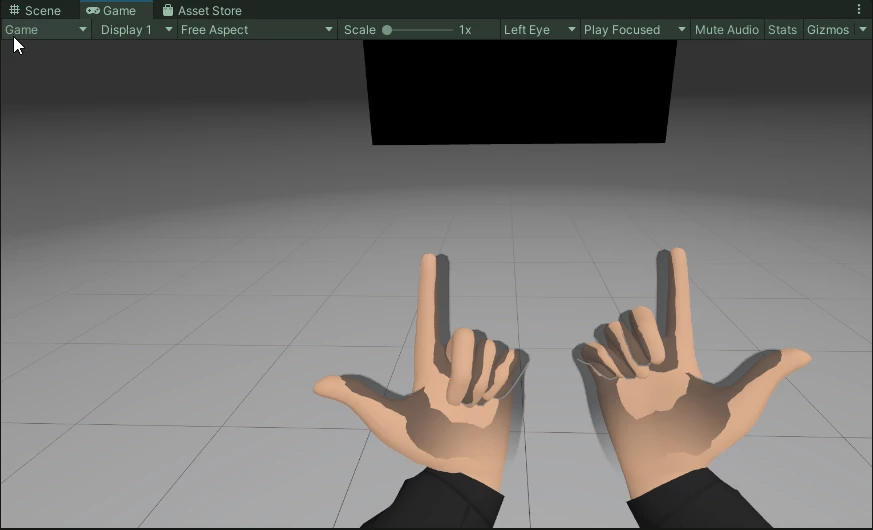
I have been trying to work out how to implement the custom hands in Unity. I got it mostly working, except the hands are very buggy when moving. I tried to search through google, reading forums / watching videos but can not seem to find a solution. I did set the frames to 90 in the time settings and while that did improve it, it is still very laggy. I'm not sure if this is a bug or not, does anyone have any info they could share?Thanks. Jay.
All is in the title!
I created my VR app in Unity 2019.1.4f1 and Oculus plugin 1.36 for the Rift. The build failed the technical tests for VRC.PC.Functional.3 and VRC.PC.Input.2, because the app doesn't pause when the Dash is open. The app does pause when the headset is removed. An Oculus blog addressing common submission issues said that one resolution for these issues would be that "Run in Background" in Unity's Player Settings/Resolution and Presentation should be unchecked, however that's already the case with the build.I also have a VRC.PC.Input.9 "focus aware" failure. But I didn't think that issue applies to the Rift, because the focus aware feature can only be enabled on the Quest. Do I need to turn off the focus aware feature in my app? If so, how to I do that?If anyone can provide assistance I would greatly appreciate it.
Adding in my vote for an offline installer. I work in a SCIF and there is NO option for an online driver installer. We own 4 DK1's, 4 DK2's, 4 CV1's (Which we are struggling to use) with a potential to buy thousands for our agency.
FOR an INDI Company selling a average headset you might want to get some more working on your production line.. Rift S been not available for how long?
Already have an account? Login
Enter your E-mail address. We'll send you an e-mail with instructions to reset your password.