Unity Development
Recently active
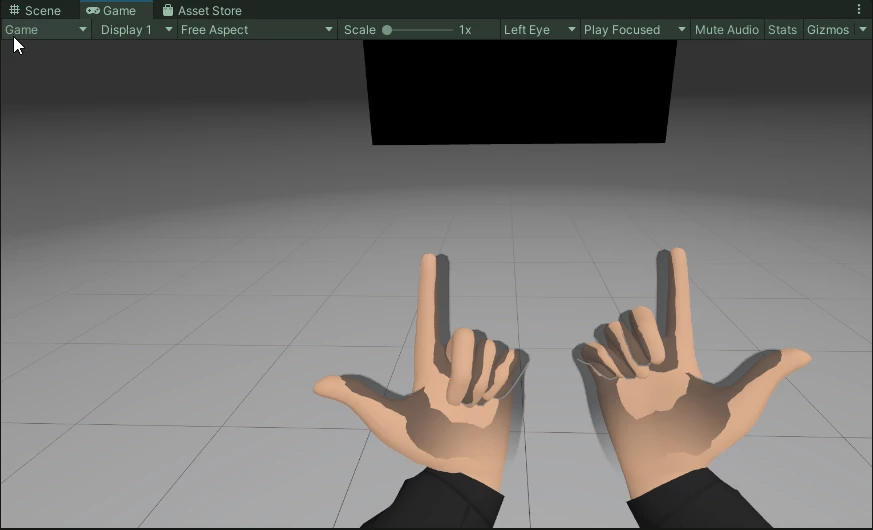
Goal: I’m working with a Quest 3 headset and controllers to develop a VR app that tracks: virtual hand (meta sdk hand tracking) on one side and the MXInk on the other side. Problem: When I open the "SimultaneousHandsAndControllers.unity" sample scene in Unity 2021.3.45f, the sample works fine, I see one one side the controller and the virtual hand on the other side. However, as soon as I power on the MXInk controller, the virtual hands disappear, and only the MXInk controller is tracked.I’ve spent the last two weeks experimenting with different controller settings, but I haven’t been able to get it to work. Has anyone experienced this issue or found a solution? Any guidance would be greatly appreciated! Thanks!
Hi,I am using the Unity Movement SDK to controle an Avatar in my unit scene.I want the player to sit in front of a table in real life and place his hands on it. In VR, the hands should also be on a table.I can roughly adjust it so that the hands are on the table. The only problem is that there are always small inaccuracies when tracking and the AVatar's hands keep disappearing into the table.Is there a way to prevent the hands from sliding through the table and always lying on it?
I'm rotating an object using Hand Grab Interactable in Meta SDK, that I have constrained between -45 and 45 on the z rotation axis via Grab Free Transformer component. When I'm rotating into a positive z value, everything works as expected, and it gradually progresses from 0 to 45. Along the negative z axis, however, the moment the z-rotation it is less than 0, it instantly jumps to -45 degrees. Does anyone know what is going on, or how to achieve the desired behavior? It feels like when using Grabbables it supersedes some Unity stuff and typical fixes won't work. Thanks
I am using the last meta avatars sdk (v. 35) and I've added the logic to integrate the meta avatar editor inside a VR application following those rules: https://developers.meta.com/horizon/documentation/unity/meta-avatars-editor-integration .Although in the linked page the code sample is totally different compared to the actual code in the OpenAvatarEditor.cs, I succeed in integrating the avatar editor, but the editor panel showing up is still the previous avatar editor version (v. 24).Have anyone had the same issue? Thanks for any help!
I am working on my Virtual Reality simulation, but my idea is to use hand tracking instead of joysticks, as I am focusing on hand interaction. However, the virtual environment is slightly bigger than the room where the simulation takes place. Therefore, I need a locomotion system, and in my view, swinging arms to move should fit quite well.I have written this script and attached it to the Camera Rig (see below). Right now, when I move my hands using the mouse in the Scene view, I can see that the script recognizes the movements. However, when I test it by actually swinging my hands, there is no impact.Additionally, I have noticed a weird issue: the reference to the hands keeps getting lost. To make it work, I had to continuously call a method in the Update() function to update the reference. I assume this issue might be related to the problem.What could I do to solve this and properly implement hand-swing locomotion?using UnityEngine;using System;using Oculus.Interaction.Inpu
Hi,I will be happy to know if anyone succeeded to connect disk on key to meta quest 3? How to do it?the purpose is to load files from my disk on key and upload files to the disk on key. Thanksomer.
Hi,I have an issue after updating Meta Avatars from v24 to v33. Before the update, avatars were working both in the build and in the editor. Right now, after the update, avatars in the editor with connected Quest are working (tracking is ok, and no exceptions in the console). But in the build, I get new avatars (whole body - with legs), but it is standing in T-pose and not responding (tracking not working for avatar).I have been working on it for two days and tried to change all possible settings options, but nothing has changed. So I tried to build just MirrorScene from samples (Meta Avatars SDK - 33.0.0. - Sample Scenes) from my project and the result was the same - avatar in t-pose and no tracking.I am attaching logcat errors getting while running app with MirrorScene. There are some weird errors: - JsonParser problems with invalid types from [ovrAvatar2 native] - PackageManager problems with "Package quest.side.vr unavailable"Can someone help me?Log to down
I'm trying to setup a Tracked Keyboard with a Virtual Keyboard as a backup if no tracked keyboard is connected via bluetooth. I don't care if the physical keyboard is actually tracked, only if it is connected via bluetooth or not. How do I figure out if a tracked keyboard is connected in code? As a workaround I'm usingKeyboard.current.description.ToString() but this will only work with my specific keyboard model. I'm using Unity with SDK V72.0.
Hi,We are building a game for Quest 2/3 and we hit some hiccups with anti-aliasing destroying GPU utilization. In Quest 3, without GPU Utilization, our game runs around 50-60% GPU Utilization usually. However, with the 'Use Recommended MSAA' setting on OVRManager, where 4x anti-aliasing is enabled, the GPU utilization jumps to 99% leading to FPS drops.So we did an experimentation, where we just placed an empty scene with just OVRCamera object, and experimented with diff anti-aliasing options and its effect on the GPU, with these results:Anti-Aliasing option vs GPU Utilization4x ~ 50%2x ~ 33%None ~ 18%So my question is, the oculus developer docs are mentioning the cost of 4x MSAA is low and that we should turn it on, but how come its consuming 50% of the GPU in an empty scene? I'm wondering if theirs something fundamentally wrong with how we set up the project, or if this is expected behavior. Maybe I'm totally missing something obvious. Thanks!
I use the Meta XR Project Setup tool to fix recommendations. But when I close my project and open it again some of them are un-fixed again. Especially annoying is the SSAO use because that causes a ghost image to appear in the headset.This is for All in one SDK 71.0.0 in Unity 2022.3.20f1Anyone seen this as well? Is there a fix for it, otherwise I'll file a bug report.Thanks!
We'd like to have a companion mobile / webgl build for our application. The meta sdk is making this impossible to do with the same unity project.In unity 6 with v69 of meta sdkWhen switching to webgl we get this error: Library/PackageCache/com.meta.xr.sdk.voice/Lib/Wit.ai/Scripts/Runtime/WitRequest.cs(376,17): error CS0103: The name '_log' does not exist in the current contextLooking at the code, it appears that this _log does indeed not exists. Because this is now in packages, we cannot simply comment out this line.I am starting a 2nd project but this is just a minor programming mistake that should be addressed to allow others to not have to make a 2nd project for this type of functionality.
Hello, when I use the Meta Haptic SDK on Android, I have no problem. But when I want to build for a macOS player and use it with meta XR simulator, I get the following error: “Error: This platform is not supported for haptics.” The disadvantage is that the player is then blocked and I can't use the Meta XR simulator. Ideally, a warning would occur but not an error. Can you suggest a workaround that would allow me to keep haptics on my metaquest 3 and disable it in the simulator? It would be great if the SDK also supported the MacOS platform now that the simulator works on it.
Hi,Up to 0.72, physical space features could be disabled and the camera feed would still show in video recordings on boundaryless apps. This was essential to avoid the 'Moved Too Far' notification which is confusing, game-breaking, and overall unnecessary.Now in 0.74, physical space features disables the camera feed. Can someone explain these seemingly arbitrary, unannounced system changes that have real adverse effects on mixed reality developers?Thank you,Aidan
I have a pointable unity event wrapper component on this button visual so it executes a script or game object. however I have to manually assign it, I need it to be able to be auto-assigned from a script or even playmaker. the reason is that the same button needs to operate multiple on-off events but those change depending on where the player is. I have over 40 items now and I would have to create 40 buttons to accommodate this. I would like it not to be hard-linked but assignable, which is then hard linked. Depending on where the player is, the hard link will be changed to the appropriate game object. Is this even possible?
All of a sudden my ray interactors aren't working when I add the building blocks using the Interaction SDK. My rays aren't interacting with anything now. Can somebody help with this? I have tried resetting the rig several times and it still doesn't work. I can interact with any of my game with the rays.
Hello, I am using the full body avatar sdk and if you use the example scene for animating the legs you will find a significant bug.Meta Avatars SDK 35unity 2021.3.38Windows 10https://youtu.be/PSUPLUaNEJMStarting at around :40 you can see that even though I am keeping my head completely still, moving the controllers around causes the third person appearance of the avatar to look in different directions. This can be very extreme, causing an avatar that should be looking directly at you to look like they are focused on something entirely different. Has anyone found a solution for this? It is limited to the leg animation example scene and it does not happen in the oculus home environment if you look in the mirror. I need to animate the avatars body and remaking everything from scratch is defeating the purpose of using a pre built system.
Hi, I'm a plugin developer, attempting to create a testable app of our UI so we can test our Platform SDK code. For this reason, we do not have any other SDK modules, so no XR input directly or creating an actual VR environment. It opens in a 2D window in Passthrough which is our goal.Prior to version 71's release, this has worked flawlessly. Using controllers or "clicking" with fingers worked, touching worked. Since the update, on one device we cannot get any input to register to our app, not touching, gestures or controllers. On our other device, only touching is working.While I've noticed that there've been a, few, issues with Quest headsets lately, the latter headset can at least use similar apps with the controllers and gestures as well. I'd like to truly determine if the problem is with the headset(s), or with our app.After multiple days of searching for potential solutions and tinkering with the configuration in our project, I've so far found no leads and am unsure how to p
I have a strange behaviour in an app I am working on.- The "asset-files-config" have 5 files in it and used to download without a problem, but now they don't finish any more.- Some do finish to completion, but some does not.- May or may not be related, but sometimes when I update the app and try to update it in the headset the quest 2 complains there is not enough disk space, even though there is 200 GB free.- I have tried factory reset, but that did not solve it.There is no crash, no report, no errors, they simply keep running but after a short time they stop progressing. They usually stop at the same percentage.I have the latest SDK v72, also tried reverting to the old v68.Headset is updated with v74Using Unity 6 (6000.0.36f1)Curiously enough, when I test the app on Quest 3 they always finish without any problem.Note that I am testing on a test user.Any ideas what could be wrong or how I can debug this?
I am getting reports that the v71 update breaks the Open XR controller input and tracking. This is with Unity 6000.0.25f1, the Meta XR All-in-One SDK 69.0.1 along with Meta Avatars SDK 31.0.0, all using OpenXR Plugin 1.13.0. Have others heard of issues with OpenXR and v71?I normally would be using the Oculus XR Plugin, but it has a headlock bug in Editor and on the Quest and yes I tried the patch that did not work (https://communityforums.atmeta.com/t5/Unity-Development/Important-Unity-6-information/td-p/1252153).
I'm excited to work on new Unity Projects and collaborate. I'm learning Unity for grad school.
This seems to be a problem with all apps I've tried to build. Basically you exit the app via the Home button and select Quit. When you try and restart the app, it fails. It will however start on the second attempt.Note that I'm using Unity 2018.1.0f2 (64 bit) on Windows, and this also happened with an app built using a totally unmodified Oculus Sample Framework project!It appears that the app instance is not being destroyed on selecting Quit - when trying to restart the app the first time, adb reports that 'ActivityManager: Process com.company.appname (pid 1234) has died'. Other apps installed via the store don't have this issue - the process dies at the point of selecting Quit. The only hint I currently have at what's going on is the following output from adb when attempting to quit:08-09 17:44:51.301 10079 10079 E ActivityThread: Activity com.unity3d.player.UnityPlayerActivity has leaked IntentReceiver com.oculus.vrapi.ScreenCaptureReceiver@220e616 that was originally registered
Had a nightmarish experience with crashing that ended up being related to my video players when I released an update for my game. Took me 8 hours straight to fix. Hope this can help anyone else working with video players on Quest in Unity. I'll be addressing the errors I got in my adb logs when my game was crashing. These were mainly happening on Quest 3. AndroidVideoMedia: Error -10000 while configuring codec.I think this happens when the hardware is getting overloaded. I was using 1920 x 1080p videos, and I could have up to 7 at one time. I reduced the amount of concurrent video players to 3 at max, and I reduced the resolution and bitrate of the video clips.AndroidVideoMedia: Error 1100 while starting codec.I think this happens when you use a video clip that doesn't meet the Android supported format standards (https://developer.android.com/media/platform/supported-formats). It could also just be an issue with Unity transcoding in general, I'm not sure. Basically, I go
After v71 of XR Simulator started working for unity 6 I was happy I can playtest my game easily. But after a day only a white screen pops out. Unity 6 28f1 . I can clearly see the black occlusion but even no input is being registered
I'm trying to create a platform that can be grabbed and moved along the y axis. And the user should also be able to rotate it around the y axis. I've added a GrabFreeTransformer and I'm constraining X and Z position as well as X and Z rotation. Now when I grab the platform and try to rotate it, it rotates the wrong way around when grabbed somewhere near the edges. When I grab it towards the center it rotates as expected. I think it might have to do with the rotation taking the point where I grab the platform as anchor. Is there any way to set the "anchor point" of the grab to always be the center of the object? Or is there any other way to get the behaviour I'm looking for? Thanks!
I'm using the openXR plugin, with hand tracking checked off. When I try to run my game, I can double tap my controllers to enable hand tracking, and this ruins my experience, because it's a controller centric game. How can I disable this feature? I just tried in Gorilla Tag and they have it disabled.
Already have an account? Login
Enter your E-mail address. We'll send you an e-mail with instructions to reset your password.