Unity Development
Recently active
Hi.Following the setup from here (https://www.youtube.com/watch?v=JttsJhSc00E) and the app is freezing displaying the splashscreen.I am using Unity 2019.2.3f1, Oculus Unity plugin 1.40, Oculus Android 1.38.3.Any ideas why?Thanks!In the logcat I see:09-18 08:51:06.934: I/Unity(3052): SystemInfo CPU = ARMv7 VFPv3 NEON, Cores = 3, Memory = 3790mb09-18 08:51:06.934: I/Unity(3052): SystemInfo ARM big.LITTLE configuration: 3 big (mask: 0xe0), 0 little (mask: 0x0)09-18 08:51:06.934: I/Unity(3052): XR UsableCoreMask: 0xe009-18 08:51:06.935: I/Unity(3052): ApplicationInfo com.Company.xr.app version 1.1 build 1ade1f29-4d3b-4975-a1b0-831ab397fdf909-18 08:51:06.935: I/Unity(3052): Built from '2019.2/staging' branch, Version '2019.2.3f1 (8e55c27a4621)', Build type 'Release', Scripting Backend 'mono', CPU 'armeabi-v7a', Stripping 'Disabled'09-18 08:51:07.062: E/Unity(3052): Unable to find libAudioPluginOculusSpatializer09-18 08:51:07.081: D/Unity(3052): GL_OES_EGL_image GL_OES_EGL_image_extern
Hand tracking is not recognized when running another app from the current app.However, if you take off the hmd and use it again, hand tracking is captured.How to switch between controller and hand in real time
When I try to build in Unity using OVR Build and Run I get the following error: Multiple ADB devices connected. Cannot perform OVR Build and Run. When I log the devices I get my Quest 2 and an emulator. I have no idea where that adb emulator comes from, but it also show up in the Oculus Developer Hub and I can't seem to kill it using the command line. Does anybody have an idea how to fix this? Also I don't really need the run functionality, as I was mostly interested in the reduced build times from OVR Build, but the option to just build (that's in this documentation) doesn't show in the menu bar. Edit 1: This last part has been fixed, by removing the oculus package all together and redownloading and installing. The mystery emulator is still a problem though. Edit 2: Ok it seems fixed now, after I updated the oculus package I could specify the device in Unity's build settings.
My Rig has been working for a year with no problem but today when I opened up my project the rig only tracks my headset and not the controllers. Using both Quest 1 and 2, both with the same problem. Been searching like a mad man for a solution with no luck so far. Anyone know what the problem might be? Thanks
Using the InputOVR prefab from the Interaction SDK, the stuff under Controllers/LeftController and Controllers/RightController still appear even when the controller is inactive, set aside. They appear in front of my face, even though I have the origin at floor level. Maybe the connected property on the IController is giving a false positive?
Hi,I am currently developing a multiplayer VR Experience in Unity with Oculus SDK Integration. Our company has some strict Firewall settings and I need to tell our IT department IP Addresses ports and protocols for new rules sets.My current issue is, that I cannot use the Oculus store, friend list and the SDK is not able to load the custom avatars via ID from the Oculus servers. We already implemented some rules.We already set IP range 31.13.84.xxx TCP / TLS and 69.171.250.48 but still seem to be missing something.My app only loads the default avatar but not the customisation. Everything works when using a normal Internet connection, so its definitely our IT's firewall fault.It would be nice to get an exhaustive list of IP addresses and Ports to open, that I can send to our IT department to properly use all Oculus services.Best
I ran into this issue:https://forum.unity.com/threads/crash-when-using-groupshared-memory-constant-buffer-on-opengles3.1256898/ Are anyone on this forum having success with ComputeShaders using groupshared memory and constant buffer reads? All the bestCarl Emil
So, I'm trying out the Meta Avatar SDK using Unity. I haven't quite got it to work yet, but one thing I notice is that the file size of the APK of one of the demo scenes is about 220Mb. Is this normal? I was wondering what is causing it to be this big and noticed in the Assets/StreamingAssets/SampleAssets folder are some large zip files of about 50Mb each for different platforms. With names like: PresetAvatars_Quest2.zip So it seems like the APK contains avatar graphics for 3 different platforms. This seems kind of odd, since why is this in the APK and not part of the Oculus OS? People only have 64-128Gb of memory on the Oculus so we don't want large file sizes containing duplicate Avatar graphics. It seems very inefficient. If I have to use 200Mb to include people's Meta Avatars in my games, then I think I will skip it. Unless there is something I'm doing wrong?
Dear Developer, After installing the Oculus Integration in Unity version 202.1.1.7 i received the error message: Library\PackageCache\io.extendreality.zinnia.unity@1.14.1\Runtime\Tracking\CameraRig\Operation\Extraction\PlayAreaDimensionsExtractor.cs(49,17): error CS0103: The name 'Boundary' does not exist in the current context" I have inserted these lines of code in the Manifest JSON file:"scopedRegistries": [{"name": "npmjs","url": "https://registry.npmjs.org/","scopes": ["io.extendreality"]}],"io.extendreality.vrtk.prefabs": "1.1.11", I am stuck now, what went wrong? what is the solution ?RegardsGerard
I am having an issue I believe is specific to the latest v37 release. I tried to update a v35 project to the new v37 and got the following error when starting up the project. I would downgrade to v35 again and have no issue. Each time I try v37 I get the following error on start up. Project crashes if I try to run. Failed to load OVRPlugin.dllUnityEngine.Debug:LogError (object)Unity.XR.Oculus.OculusLoader:EditorLoadOVRPlugin () (at Library/PackageCache/com.unity.xr.oculus@1.11.2/Runtime/OculusLoader.cs:237)UnityEditor.EditorAssemblies:ProcessInitializeOnLoadMethodAttributes () I am using package manager and the oculus integration archive to get the v37 and v35 package. I have the Oculus XR Plugin and XR Plugin Management set up properly. I have tried with multiple unity versions 2021.2.10, 2020.3.22, 2021.2.5. I really want to try the interaction SDK but this strange issue is getting in my way.
Hi all, I added the ovrcamerarig to my scene as per this guide: https://developer.oculus.com/documentation/unity/unity-handtracking/ I added the OVRhandprefab ynder the left and right anchors. Everything works fine for hand tracking, but when I pick up my controllers, the hand models disappear and I have no hands at all. Do I need to set something somewhere to keep the hand models visible when I switch to controllers? Thanks
I have events that are meant to fire specifically when the Quest is put on/taken off. These have worked perfectly up until I upgraded the Oculus Integration to 31.0 (worked fine with Oculus Integration 29.0 with Unity 2021.1.10f1) Root cause [as far as I can see] is that the boolean at OVRPlugin.userPresent is not updated properly. Also, to be perfectly accurate: They fire once when the app is opened, then again when the app is closed or the headset goes into standby (pressing the power button, for example), but not when the Current versions:Unity 2021.1.16f1Oculus Integration Version 31.0Running on a Quest V1, v31.1.0.102.370.308659911 Anyone else experiencing this?Thanks!
Hi, maybe im doing something painfuly wrong and obvious but im just not seeing it yet. What is currently happening is that an APK that worked on my previous oculus 1 in wich the game run good is now facing serious performance issues. The same game nothing has changed. The only this that has changed is the headset. In summary the build on the Oculus quest 2. Now runs at 1 FPS MAX and then proceeds to crash. And this is obviously something wrong with a setting or something that will make the build run fine on the oculus quest 2. But im just to much of a newby to see it. Btw the headset is fine. I have tried playing others standalone games on the quest and there is nothing wrong on that side. Another btw im on Unity 2019.4.25f1
I tried out this Spectator Mode demo (https://developer.oculus.com/documentation/unity/unity-spectator-camera/) from the new Oculus Integration 29, but discovered that initiating the camera switch (with trigger) while casting will crash the app it was built with the "Development Build" option.
Hello all, I am trying to use a combination of the XR Ray Interactor to interact with UI and the Oculus Custom hands to grab objects.. When I use the XROrigin with ray interactor and XR Grab Interactable I am to view the ray as well as grab objects (very laggy/glitchy though).. One major issue with the XROrigin setup is that they movement in VR is passing thorough the environments walls and objects.. I have tried applying Physics by adding Rigidbody components but it isn't very smooth and it is slightly uncomfortable when viewing in the headset.. So I am trying to use the OVRPlayerController with OVRGrab functionality as well as the XR Ray Interactor but the rays don't show up. I am not sure If I am missing anything.. any help on this would be very much appreciated... Thanks in Advance Platform: AndroidUnity version: 2020.3.27f1XR Toolkit Version: 2.0.1Oculus Integration Package version: 37.0
I want to display small Unity UI elements to the player that can change dynamically. I at first tried to just use a canvas set to screen space but it didn't render to the screen. I tried to use the OVR Overlay except I can't figure out how to make it lock to the player's head. Are there any solutions to the problem I am trying to solve? (Using Oculus Quest 2)
I was playing around with the Oculus Integration Package for Unity along with Hand Tracking. I was wondering if it possible to have both Hand Tracking and the Controller enabled during the execution of the project. I was thinking of using hand tracking for the player to grab objects around them, and I wanted to use the controller, more specifically the location be translated in real time in the Unity environment and me, as the player, can walk up and pick the object which is my controller. Essentially, I want to use the location sensors in the controller and utilize those values within my project, while also using hand tracking. I know that when I switch to hand tracking the controllers turn off and vice versa so I'm a little confuused on if its possible, I talked to a Oculus Support Staff and they said it possible, but I was wondering if anyone here has tried it and found a solution.
Hey all, I'm trying to create an effect where there are hidden objects in the scene, which you only see if they're within a certain area of your vision. I had gotten the effect to work with a single camera by setting hidden objects to a specific layer, adding a second camera as a child to the first with a Culling Mask set to that layer, setting Clear Flags to Depth only, setting the Depth to 1 (greater than the main camera) and then cropping the Viewport Rect to the area I was interested in. However in porting this to the Quest, the effect breaks entirely. If I create a child camera for each eye, I see the rectangular area I'm interested in, however it's all black, and only appears in one eye. If I just create a child camera for the center eye, my entire vision is black. Do any of you know why rendering multiple cameras would cause an issue like this? Or can you think of a way to achieve this effect without multiple cameras?
I have had this issue for at least a week.The Quest will stop tracking position and rotation when I put the headset on. It has happened in the Home environment. It has also happened when I open my built app, when I have Link Mode active with my desktop, and when running my app through Oculus Link from Unity on my desktop. It also stops detecting the controllers altogether.I have experienced this on two separate Quests, both running V37 (Runtime 37.0.0.135.110.344258839). (I have more than 2 Quests, but I do not use the rest as often)Issue is intermittent, but moderately frequent. The first time it happened was a week ago. Some combination of waiting and unmounting/mounting headset seems to fix the issue, temporarily. I cannot pinpoint a specific cause, nor a definite solution as of yet. Issue does not happen in the middle of a session, that is, I have only noticed it when I first put the headset on.I have looked at the device logs from Developer Hub, but nothing pops out to me as
I'm struggling to find something that is a full guide of how to set and/or see what the refresh is in the game you are developing.. Everything says either use the tools that come with Oculus (Support). Which yes install and host a service but it does nothing for me, not sure if its because I'm not using my GPU and just using the headset. But I would like the ability to edit a Unity file and statically set the refresh rate (which file) and/or in the game I'm developing just be able to see in it what the refresh rate and such is. Everything I see and search for ASSUMES way too much..Keep finding stuff like below but where do you put it.. I just dont create a new file and drop that in there and whala OVRPlugin.systemDisplayFrequency = 90.0f;OVRManager.DisplayRefreshRateChanged += DisplayRefreshRateChangedprivate void DisplayRefreshRateChanged (float fromRefreshRate, float ToRefreshRate){// Handle display refresh rate changesDebug.Log(string.Format("Refresh rate changed from {0} to {1
I keep getting this error, not sure what's causing it:OVRADBTool adb server version (40) doesn't match this client (41); killing...* daemon started successfullyUnityEngine.Debug:LogError(Object)OVRADBTool:RunCommand(String[], WaitingProcessToExitCallback, String&, String&) (at Assets/Oculus/VR/Editor/OVRADBTool.cs:200)OVRADBTool:GetDevices() (at Assets/Oculus/VR/Editor/OVRADBTool.cs:114)OVRGradleGeneration:OnPostprocessBuild(BuildReport) (at Assets/Oculus/VR/Editor/OVRGradleGeneration.cs:304)UnityEditor.BuildPlayerWindow:BuildPlayerAndRun()Error building Player: OVRADBTool adb server version (40) doesn't match this client (41); killing...* daemon started successfully
I'm trying to upload a file via FTP. Actually it works fine via Editor but when I make a build and push it to my Quest, I get "The remote name could not be resolved." error when I try to call FtpWebRequest.GetRequestStream(). var request = WebRequest.Create(address) as FtpWebRequest;request.Credentials = ...request.KeepAlive = false;request.UseBinary = false;request.Method = WebRequestMethods.Ftp.UploadFile;request.ContentLength = fileInfo.Length; Then I call request.GetRequestStream() within a try/catch and it throws the timeout exception. I tried adding <uses-permission android:name="android.permission.INTERNET" /> line to my AndroidManifest.xml thinking this might be the issue, but alas no change. Perhaps related but my attempts to get Leaderboard/Achievement data also has errors:Unable to resolve host "graph.oculus.com": No address associated with hostname Both Leaderboards and Achievements work fine via Editor - only when I push a build to my device.
Unity forum post here:https://forum.unity.com/threads/video-and-project-included-quest-2-camera-rendering-goes-crazy-if-main-camera-does-not-move.1251660/ When the user moves their head and the game camera does not move, the Quest 2 rendering seems to go crazy.It seems to expect the game camera to move with the user's head and has some kind of head tracking compensation that affects rendering. Is there some way to turn off this behavior temporarily?I have specific moments where the game camera deviates from the user's motion.And this head tracking compensation for rendering is causing it to look like my framerates are dropping when it isn't.
Hello all I've created a new scene, imported the interactables from the basic grab scene and then brought in the OculusInteractionSampleRig prefab, as the one included in the basic grab scenes seems to have missing scripts.I am currently trying to create a controller, starting with being able to pick objects up using hand tracking.I can see the reference material on hand grabbable objects here:https://developer.oculus.com/documentation/unity/unity-isdk-hand-grabbable-object/ My general issue that there's now a lot of different components on each of the grabbable objects and on the OVRController itself. I'm looking to learn the interaction SDK (I've previously used the XR interaction toolkit but would love to switch the controller out for an OVR controller), but I'm finding it difficult to know just how to go about learning it. My general questions for this post are:How should I go about learning how to use the interaction SDK to build a controller?Is ther
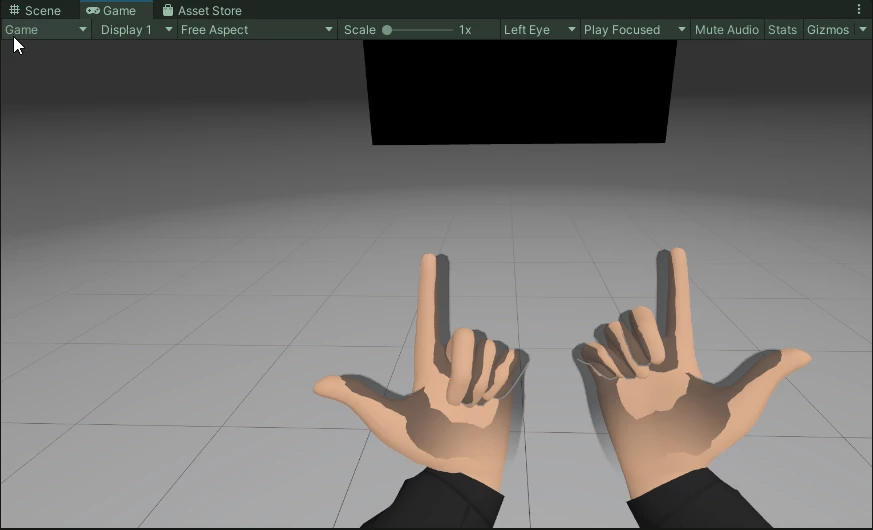
Hey,I wanted to implement locomotion for controllers and hands. While the locomotion works fine with controllers, the hands do not move correctly. I am using the rig included in the SDK used in the samples scene:("HandVisual" and "HandSynthetic" behave the same, I tried both) When moving or rotating the rig the colliders and pointer pos etc. are all correct, but the visual moves faster than the rig itself. For example: if I move the rig 0.3 in the Z direction, the hands look like they are at 0.6 in Z direction.You can see this behavior in this image: The settings of the hand visual script are the default ones:Changing them completely breaks the hand position (they are stuck at 0,0,0) and only the fingers are updated. Maybe someone can help me with this. SDK Version: v37 for Unity
Already have an account? Login
Enter your E-mail address. We'll send you an e-mail with instructions to reset your password.